
1. Introduction
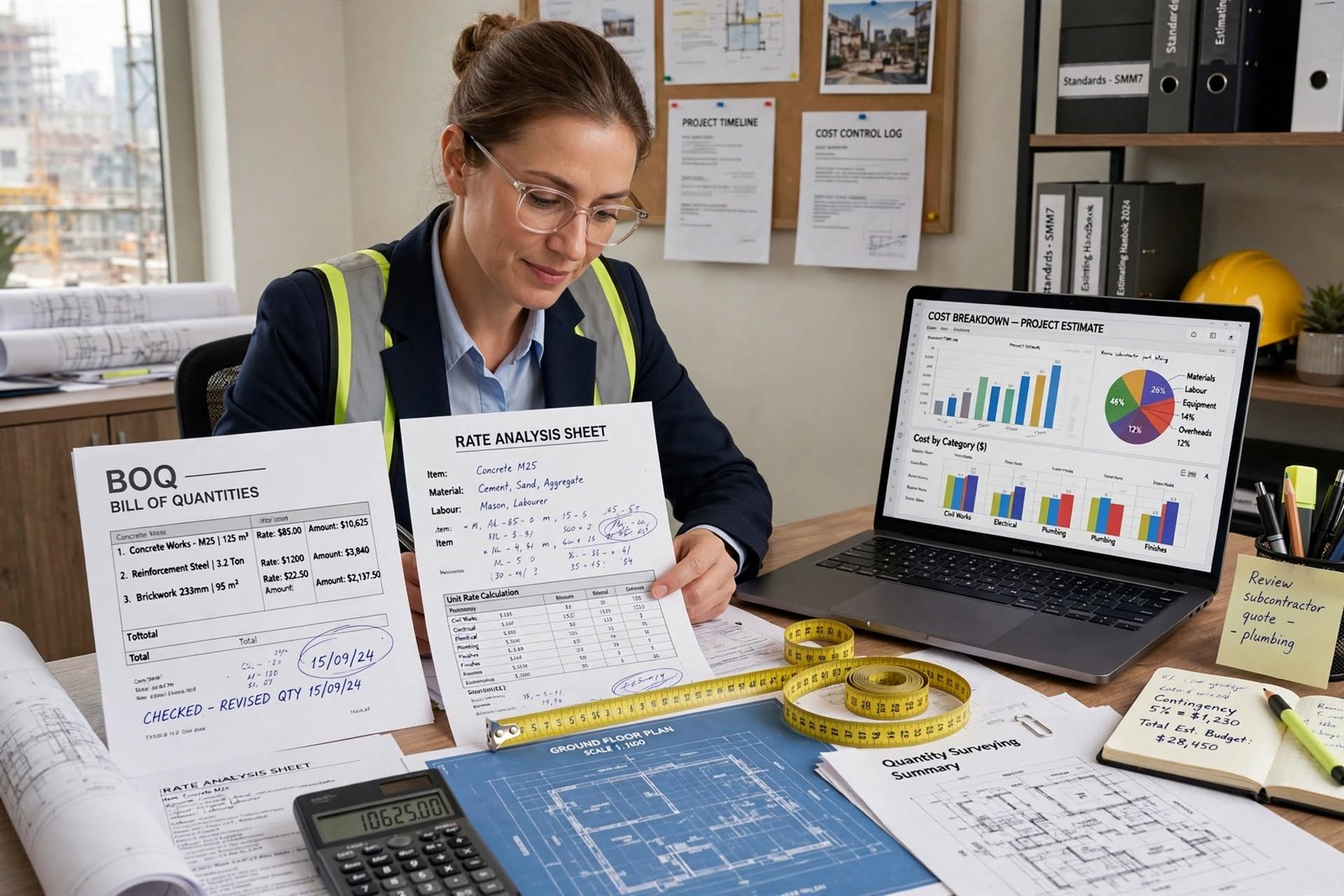
Cost estimation and quantity surveying are essential disciplines in construction management. They involve predicting the costs of a project, measuring the quantities of materials and labour required, and controlling expenditures throughout the project lifecycle. Accurate cost estimation is critical for project feasibility, budgeting, tendering, and financial success.
Whether you are a homeowner planning a house, a developer evaluating a commercial project, or a government agency tendering infrastructure works, cost estimation is fundamental to decision-making. Errors in estimation can lead to cost overruns, project delays, disputes, and in extreme cases, project abandonment.
2. Types of Cost Estimates
2.1 Approximate Estimate (Preliminary Estimate)
Prepared during the early stages of a project to assess feasibility. Based on rough quantities, unit rates, and previous project data. Accuracy: ±20–25%.
2.2 Detailed Estimate
Prepared after design is complete. Based on accurate quantities taken from drawings and current market rates. Used for tendering and budget approval. Accuracy: ±5–10%.
2.3 Revised Estimate
Prepared when the original estimate is exceeded by more than 5% or when there are significant scope changes.
2.4 Supplementary Estimate
Prepared for additional work not covered in the original estimate.
2.5 Annual Repair Estimate
Prepared for annual maintenance and repair works of existing structures.
3. Methods of Cost Estimation
3.1 Unit Rate Method
Cost is estimated based on the built-up area and a standard unit rate per square foot or square meter. Common for residential buildings. Approximate but fast.
3.2 Plinth Area Method
Cost is estimated based on the plinth area of the building. Uses published plinth area rates for different building types.
3.3 Cubical Content Method
Cost estimated based on the cubical content (volume) of the building. Suitable for multi-storey buildings.
3.4 Approximate Quantity Method
Based on approximate quantities of major items like cement, steel, brickwork, and their standard consumption rates.
3.5 Detailed Item Rate Method
The most accurate method. Each item of work is measured from drawings and priced at current market rates. Used for detailed estimates and tendering.
4. Rate Analysis
Rate analysis is the process of determining the unit rate for each item of work. It involves:
- Material Cost: Cost of materials including wastage
- Labour Cost: Wages for skilled and unskilled labour
- Plant & Machinery: Cost of equipment and tools
- Overheads: Site overheads, supervision, temporary works
- Profit: Contractor's profit margin
- Taxes: GST and other applicable taxes
4.1 Example: Rate Analysis for Brickwork (1:6 Mortar)
- Bricks (500 nos. @ ₹8) = ₹4,000
- Cement (1.5 bags @ ₹400) = ₹600
- Sand (0.3 m³ @ ₹1,500) = ₹450
- Labour (Mason + Helper) = ₹500
- Total = ₹5,550 per m³
- Add 15% overheads & profit = ₹6,382 per m³
5. Preparing a Bill of Quantities (BOQ)
A BOQ is a document that itemizes all materials, parts, and labour required to complete a construction project, with their quantities and rates. It forms the basis for tendering and payment.
5.1 Structure of a BOQ
- Preliminaries and general items
- Earthwork and site preparation
- Concrete works (PCC, RCC)
- Reinforcement steel
- Formwork
- Masonry works
- Plastering and finishing
- Flooring and tiling
- Plumbing and sanitary
- Electrical works
- Painting
- External works and landscaping
5.2 Measurement Rules
Standard methods of measurement are prescribed in IS 1200. All measurements should be in metric units (m, m², m³, kg, etc.).
6. Quantity Surveying Techniques
Quantity surveying involves measuring and quantifying the work required for a project. Key techniques include:
- Taking Off: Systematically measuring quantities from drawings
- Centre Line Method: Used for walls and foundations
- Long Wall-Short Wall Method: Common for buildings with varying wall thickness
- Cross-Section Method: Used for roads, canals, and linear works
- Software Tools: AutoCAD, Revit, CostX, and estimation software for accurate takeoff
7. Cost Control During Construction
Cost control ensures that the project is completed within the approved budget. Key aspects include:
- Regular Cost Monitoring: Comparing actual expenditure with budget at regular intervals.
- Earned Value Analysis: Measuring project performance against schedule and cost baselines.
- Variation Control: Managing scope changes to prevent cost escalation.
- Material Management: Ensuring minimal wastage and proper storage.
- Labour Productivity: Monitoring productivity and minimizing idle time.
- Cash Flow Management: Ensuring that funds are available as needed.
Best Practice: Always maintain a contingency of 5–10% of the total project cost for unforeseen items and price escalation.
8. Common Estimation Mistakes
- Inaccurate Measurements: Errors in quantity takeoff lead to wrong estimates.
- Outdated Rates: Using old rates not reflecting current market conditions.
- Ignoring Overheads: Forgetting to include site overheads, insurance, and taxes.
- Underestimating Contingency: Insufficient buffer for unforeseen events.
- Overlooking Escalation: Not accounting for price escalation in long-duration projects.
- Ignoring Statutory Charges: Missing out on statutory fees, approvals, and permits.
- Oversimplification: Using approximate methods for complex projects.
9. Conclusion
Cost estimation and quantity surveying are the financial foundation of every construction project. Accurate estimation enables sound decision-making, realistic budgeting, and successful project delivery. Underestimating or overestimating can result in financial losses, project delays, or abandoned works.
At Construction Aid, we bring over 40 years of experience in cost estimation, quantity surveying, and cost control for residential, commercial, industrial, and infrastructure projects. Our team delivers accurate and reliable estimates that help clients plan, budget, and execute successfully.
Need Accurate Cost Estimation?
Get expert guidance on cost estimation, BOQs, rate analysis, and quantity surveying from Construction Aid.
Schedule a Consultation